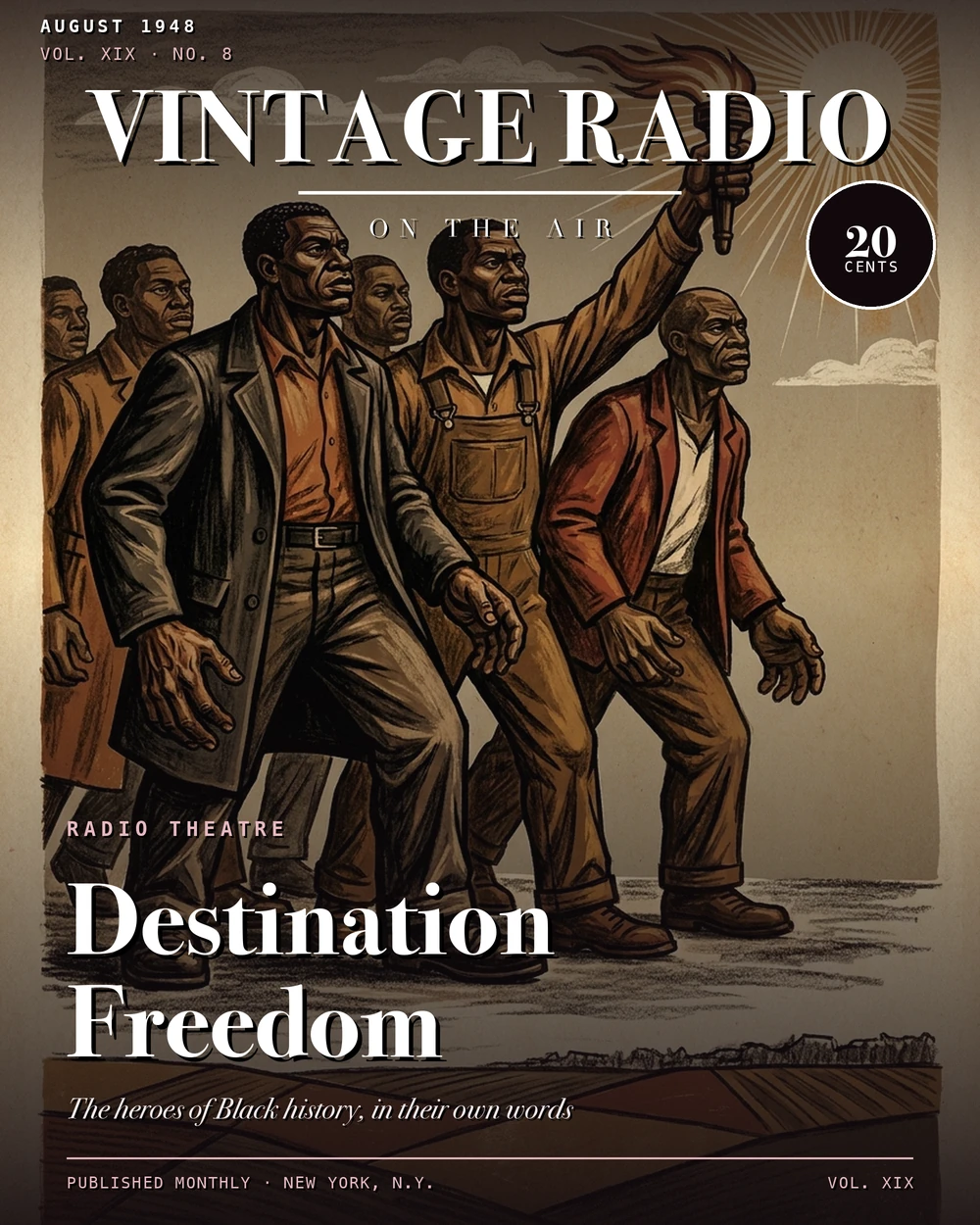
Destination Freedom
The Show That Stood Alone
Radio historian J. Fred MacDonald, a professor of history at Northeastern Illinois University, put it plainly: "Nowhere else in radio history did a single series, written by a single talent over as long a period, project such a strident reminder of liberties denied and rights abused." That was Destination Freedom, and it aired not on a national network but on a single Chicago station, WMAQ, in the Sunday morning public-service timeslot — what one researcher called "a virtual graveyard for any dramatic programming." It ran from June 27, 1948 to August 13, 1950, thirty minutes a week, and it opened every episode with a stanza from the spiritual "Oh, Freedom." There was nothing else on American radio quite like it.
The show's original purpose was to dramatize little-known lives from Black American history and culture. But it didn't stay purely historical. As the series found its footing, it widened its scope to take on contemporary life: the Black experience inside a modern racist society, the institutions that perpetuated segregation, the slow grind of discrimination in daily life. It used the words "Jim Crow" as a plain adjective — which writer Richard Durham later noted was unusual, if not unique, for American radio. The show featured no buffoons, no stock comic figures. Durham's characters were heroes, villains, lovers, parents, brutes. They were Joe Louis, Jackie Robinson, Lena Horne, Frederick Douglass. They were ordinary people caught in extraordinary circumstances of injustice.
Arthur Peterson, a white character actor who worked on the show, recalled that before Destination Freedom, there were no Black performers in serious dramatic radio. His wife, Norma Ransom, who also worked on the series, said she could not think of a "single black actor" who had made any significant inroads in white radio. The contrast on Destination Freedom was deliberate and complete: Black performers were the stars; white actors carried the supporting roles.
Richard Durham and How He Made It
Richard Isadore Durham was born September 6, 1917, in Raymond, Mississippi, and moved with his family to Chicago around 1921. A 1947 study by the National Negro Congress concluded he was likely the only African American then working full-time as a radio scriptwriter anywhere in the country. He had come to the craft through the Illinois Writers' Project in the late 1930s, documenting Depression-era Chicago life, and had spent the early 1940s writing scripts covering figures like Francisco Goya and Henri Matisse for WGN's Great Artists Series. He honed his skills through his connection with the South Side Writers Group — Arna Bontemps, Frank Marshall Davis, Margaret Walker, and Richard Wright were among its members — and as a teenager he had sent poems to Langston Hughes, who wrote back with editorial guidance.
By the time WMAQ program director Judith Waller approved Destination Freedom for broadcast, Durham had already created two earlier radio series: Democracy USA, which profiled African-American figures in 15-minute episodes on WBBM from 1946 to 1948, and Here Comes Tomorrow, described as the earliest known Black soap opera, which aired on WJJD and followed the post-war struggles of the Redmond family. Both left the air in spring 1948 as he shifted his attention to the new WMAQ project. The inspiration for the approach came partly from a special broadcast in which director William N. Robson had probed the causes of the Detroit race riots — Durham saw what radio could do when it took the subject seriously.
Durham's writing process was methodical. He researched each episode through hours of work at the George Cleveland Hall Branch of the Chicago Public Library, with the assistance of librarian Vivian Harsh. He submitted the name and a brief description of each character he wanted to dramatize, and they were generally approved. In a 1983 interview, a few years before his death, he said he had spent considerable time studying Dickens and drew on Dickens's technique of setting characters quickly and sharply. WMAQ retained final approval over all scripts and did not infrequently demand changes — episodes about Nat Turner and Paul Robeson were deemed too controversial and rejected outright — but Durham said he could not remember ever being pressured to soften the show's rhetoric on the episodes that did air.
Waller, who had been involved in bringing Amos 'n' Andy to WMAQ nearly two decades earlier, was, by Durham's recollection, "quite enthusiastic" about the new kind of characterization the show offered. What had been proposed as an experiment "for a few weeks" ran for more than two years.
The Cast and the Craft
The ensemble Durham assembled was substantial. Fred Pinkard played most of the male leads during the first year. Oscar Brown Jr., born in Chicago on October 10, 1926, started in bit parts and gradually worked his way up to share top billing with Pinkard. (Brown had also appeared in Durham's earlier Here Comes Tomorrow and co-produced a Chicago radio program he described as making him the "world's first Black newscaster.") Wezlyn Tilden and Janice Kingslow were the principal female leads — Tilden went on to a long stage career, while Kingslow largely disappeared from the Chicago performing arts scene after the show ended. Studs Terkel, still years away from his later fame as a social historian and Chicago talk show host, worked on the series. Vernon Jarrett, who later became a prominent African-American journalist in Chicago, appeared in the cast. Hope Summers, Tony Parrish, Jack Gibson, Harris Gaines, Louise Pruitt, Boris Aplon, and a number of others rounded out the regular company. Hugh Downs served as one of the announcers. Music came from Emil Soderstrom, Jose Bethancourt, and Bobby Christian.
White character actors took supporting roles. Arthur Peterson, who could perform Black dialect, worked alongside his wife Norma Ransom. Forrest Lewis was part of the company; the Petersons recalled that Lewis could "play a great old black man." Homer Heck — who had spent five years directing Vic and Sade before arriving at WMAQ — was one of the directors, alongside Dick Loughran.
Durham's storytelling devices were consistently inventive. In "The Trumpet Speaks," Louis Armstrong's trumpet was personified as a verbal guide through the musician's life. In "The Heart of George Cotton," a human heart narrated the drama during an open-heart surgery sequence, paying tribute to surgeons Daniel Hale Williams — the first doctor to successfully suture a human heart, in 1893 — and Ulysses Grant Dailey. In "Anatomy of an Ordinance," Durham personified urban slums as an arrogant character proud of its discriminatory origins. In "The Rime of the Ancient Dodger," he used humorously rhymed verse to tell the story of Jackie Robinson's 1947 integration of major-league baseball, with Studs Terkel playing "Sammy the Whammy," the episode's narrator.
The Subjects It Took On
The range of subjects Destination Freedom covered over its Durham run was extraordinary. Early episodes reached back into history: "Railway to Freedom" dramatized Harriet Tubman and the underground railroad; "Dark Explorers" covered Black people who crossed from Europe on the earliest ships. Subsequent episodes dealt with Denmark Vesey, Frederick Douglass, George Washington Carver, and Richard Wright's Black Boy. The show covered Louis Armstrong, Fats Waller, and Nat King Cole. "The Tiger Hunt" told the story of a Black tank battalion in World War II; "Last Letter Home" focused on Black pilots. Recovered transcriptions included episodes on Ralph Bunche, Satchel Paige, Sugar Ray Robinson, Roscoe Dungee, and Lena Horne — the Horne episode depicting her encountering bigotry in a Jim Crow café between flights. The full roster of figures dramatized extended to Toussaint L'Ouverture, Sojourner Truth, Ida B. Wells, W.E.B. Du Bois, Langston Hughes, Mary Church Terrell, Katherine Dunham, Gwendolyn Brooks, Booker T. Washington, Carter G. Woodson, and many others.
"Segregation Incorporated" took on the National Committee on Segregation in the Nation's Capital. "The Case of the Congressman's Train Ride" dramatized attorney Richard Westbrooks's representation of Arthur Mitchell before the U.S. Supreme Court. "A Garage in Gainesville," broadcast September 25, 1949, depicted a white man expected to help a mob lynch his African-American business partner on a false accusation; "Execution Awaited," the following week, staged a simulated court trial in which racial prejudice itself was the defendant. Both episodes were added to the Library of Congress National Recording Registry in 2016.
The show drew real opposition. A group Durham described as "15 or 20" members of the White Knights of Columbus marched at the WMAQ station, denouncing the show, for three or four weeks. The Knights of Columbus, the Chamber of Commerce, and the American Legion all lodged complaints about particular episodes during the run. At the same time, civil rights organizations gave the show strong support. Illinois Governor Adlai Stevenson commended the program on the anniversary of its first episode for its efforts to increase racial tolerance. The show received a first-place commendation from the Ohio State University Institute for Education by Radio in 1949, and Durham won a Peabody Award for the episode "The Sorrow Songs — Spirituals."
Sponsorship, Survival, and Durham's Departure
Destination Freedom was sponsored for its first thirteen weeks by the Chicago Defender, one of the country's most historically significant Black newspapers. That sponsorship ended partly because cast member Oscar Brown Jr. ran for political office on the Progressive Party ticket in 1948, opposing a candidate the Defender had endorsed. A handful of episodes in early 1950 received partial sponsorship from the Urban League of Chicago. For most of its run, WMAQ bore the full cost — spending an estimated $15,000 to $18,000 a year to sustain the series. Durham himself was never part of the WMAQ staff; he worked throughout as a freelancer.
The end came when WMAQ brought in a new director, John Keown, in 1950. Durham described Keown's treatment of his scripts as "butchery I could no longer endure." He left the series, lured by a network offer to write a "Don Ameche vehicle" that paid significantly more than the sustained local program. On his way out, he said: "we hadn't scratched the surface on the theme." He held the copyright to the Destination Freedom name and immediately sued WMAQ when the station relaunched the show under the same title with a fundamentally different format.
The second WMAQ series debuted October 15, 1950 with the episode "Paul Revere Speaks" and ran through November 19, 1951. It was, in the words of one observer, "a poor man's Cavalcade of America" — patriotic dramas built around Americanism and anti-Communism, narrated by the Spirit of Paul Revere, voiced by Maurice D. Copeland. The show dealing with Black American life became a white show dealing with straight history. It lasted less than a year and produced fewer than half the episodes Durham had written.
What Survived and What It Left Behind
Around 1980, a substantial run of transcription discs from the original Durham series was discovered, and the show was heard again for the first time in decades. Transcriptions for roughly three-quarters of the Durham-era episodes came to light, helping spur research and renewed attention to the series.
J. Fred MacDonald edited Richard Durham's Destination Freedom: Scripts from Radio's Black Legacy, 1948–50, published by Praeger in 1989, containing fifteen of Durham's scripts with contextual essays and a chapter tracing the program's political history. In 2017, Sonja D. Williams — a Peabody Award-winning radio producer and professor at Howard University — published Word Warrior: Richard Durham, Radio, and Freedom through the University of Illinois Press, drawing on archives, family records, and interviews with colleagues including Studs Terkel and Toni Morrison. Terkel, for his part, described Durham as having "a certain clarity of vision as well as clarity of style," and said of Destination Freedom: "There was nothing quite like it ever on radio."
Durham's papers are held at two Chicago institutions: the Vivian G. Harsh Research Collection at the Chicago Public Library's Woodson Regional Library and the University of Chicago Library. The collection runs to 25 linear feet and includes scripts, correspondence, photographs, recordings, and proof pages from the Muhammad Ali autobiography — The Greatest: My Own Story (1975), which Durham co-authored. Among the items in the collection is a handwritten note from artist Jacob Lawrence dated May 17, 1949, providing his biographical information, and letters from Mamie Till Mobley drafted with Durham's assistance seeking documents about Emmett Till's father under the Freedom of Information Act.
Durham was inducted posthumously into the National Radio Hall of Fame in August 2007. After leaving WMAQ, his career ranged widely: national program director for the United Packinghouse Workers of America, press agent, editor of Muhammad Speaks in the 1960s, creator of the television drama series Bird of the Iron Feather for Chicago's WTTW in the early 1970s, and speechwriter for Chicago's first African-American mayor, Harold Washington. He died April 27, 1984, of a heart attack while traveling in New York City.
A revival production, Destination Freedom Black Radio Days, produced by donnie l. betts through No Credits Productions, began airing in May 1999 on KGNU in Colorado, using both Durham's archived scripts and newly commissioned material. The two Library of Congress episodes — "A Garage in Gainesville" and "Execution Awaited" — were nominated for the National Recording Registry by Ryan Ellett, a radio historian and recipient of the 2008 Stone/Waterman Award for contributions to the preservation of old-time radio. Ellett compared Durham's departure from the series to that of Carlton Moss, identified as radio's first Black dramatist, who left radio in the mid-1930s for film — both men pushed out not by station pressure but by the simple economic reality that a sustained local series couldn't pay a living wage.
The show's total script count for the Durham era is a matter of some dispute — estimates range from 91 to 105, with 97 appearing in one carefully maintained source set — but what no one disputes is the scope of what those scripts accomplished. In Sunday morning's public-service timeslot, without a national network, without consistent sponsorship, Richard Durham wrote more than two years of radio unlike anything else on the air.